


How to choose the right industrial ice machine for your business
A mid-service ice shortage stalls drink orders, seafood displays, and concrete pours alike. Oversized equipment drains capital and floor space every single day of the year. Neither failure comes from bad luck alone. Both trace back to a sizing decision made without real operating numbers.
The right industrial ice machine depends on four inputs: daily volume, ice type, installation conditions, and total cost of ownership. Work through them in that order, because each answer narrows the field well before price enters the conversation. What does your busiest hour actually demand from the equipment? Start there, and let your own numbers lead the decision.
Key Takeaways
Calculate your daily ice needs from your busiest hours and add 20% extra capacity.
Pick the ice type that fits your job: cube for drinks, flake for cooling, tube for fast chilling, block for storage.
Check your site for space, power, water, and drainage before you choose a machine.
Compare total lifetime costs, including energy, water, and maintenance, not just the purchase price.
Bring your peak-week numbers and site details to a supplier for a precise recommendation.
Size your industrial ice machine
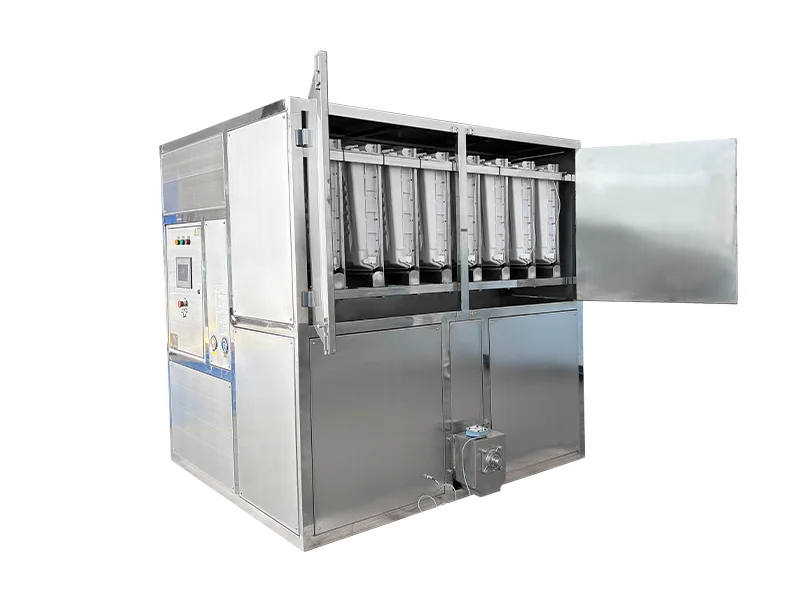
Sizing starts with a number, not a catalog page. Calculate your daily ice usage from two inputs: your business type and your busiest operating period. Each application draws ice at a different rate, so a generic capacity figure will mislead you.
Estimate demand by business type and peak hours
Start with a baseline for your category. The table below shows typical demand patterns by application.
Business type | Primary ice use | Demand pattern |
|---|---|---|
Restaurants and bars | Beverages, display, chilling | Spikes during meal service |
Fisheries | Catch preservation, transport | Heavy, sustained through landing hours |
Food processing | Temperature control, packing | Steady across shifts |
Concrete cooling | Mix temperature control | Tied to pour schedules |
Cold chain logistics | Storage and transit | Continuous, weather-sensitive |
Next, measure your peak. Count the ice your busiest hours consume, then multiply that rate across a full operating day. A restaurant that fills hundreds of drink orders at dinner needs capacity for that window, not the quiet afternoon average. Fisheries and concrete crews face the same logic: the landing tide or the pour schedule sets the real requirement.
Apply the sizing rule of thumb once you have your daily figure. Choose production capacity at least 20% above normal daily usage. Select a storage bin holding 10–20% more than typical daily usage. The production margin covers recovery after peak draw. The bin margin covers the gap between production cycles.
For reference, ICEMA Industrial Ice Machines span 1 to 100 tons per day. That range lets you match capacity directly to your calculated demand, whether you run a small processing line or a large port operation.
Plan for growth and seasonality
Your busiest week defines your worst-case demand. Summer heat, holiday service, harvest season, and construction deadlines all push consumption above the annual average. Build your calculation around that peak week, not a mild month.
Growth deserves the same treatment. A business adding seats, shifts, or contracts will outgrow a machine sized for today. The 20% production margin absorbs moderate growth without a replacement purchase. If you expect rapid expansion, size toward the upper end of your projected range.
Seasonality cuts both ways. A fishery with a short landing season needs full capacity for a few intense weeks. A beverage operator with a summer spike needs the same peak capability. In both cases, an undersized unit fails exactly when revenue matters most.
Record your numbers before you shop: daily usage, peak-hour rate, peak-week total, and projected growth. These figures turn a vague capacity question into a precise specification. Every later decision, from ice type to cooling setup, builds on this foundation.
Match the ice type to your application
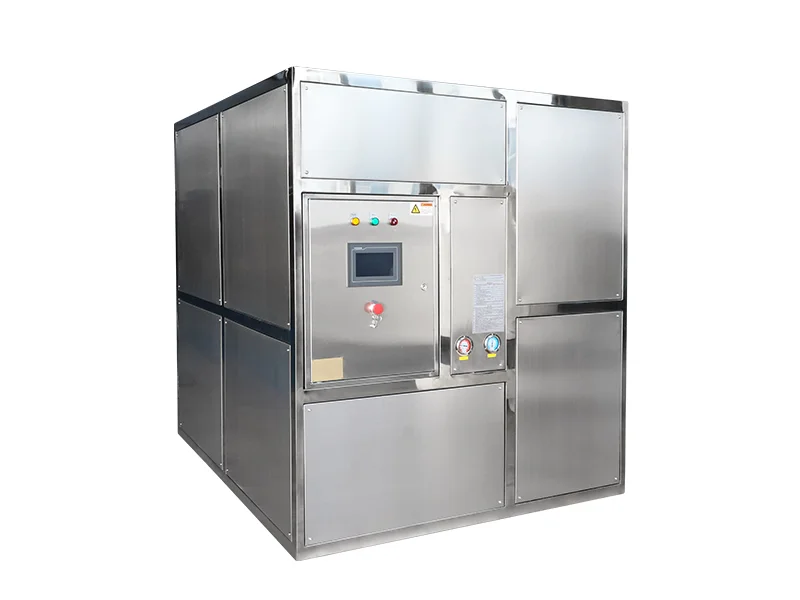
Capacity tells you how much ice you need. Ice type tells you what that ice must do. Four common formats dominate industrial production, and each one suits a different job.
Compare cube, tube, flake, and block ice
Cube ice forms in molds and freezes into clear, slow-melting pieces. It looks good in a glass and holds its shape during display. Tube ice freezes as hollow cylinders with a large surface area. That shape transfers cold fast. Flake ice freezes thin and soft, so it molds around irregular surfaces and cools quickly. Block ice freezes in large slabs. It melts slowly and stores well over long periods.
Ice type | Form | Cooling behavior | Best-fit applications |
|---|---|---|---|
Cube | Clear, solid pieces | Slow melting, attractive | Beverages, seafood display, hospitality |
Tube | Hollow cylinders | Rapid heat transfer | Food processing, rapid chilling, packing |
Flake | Thin, soft flakes | Fast cooling, molds to surfaces | Fisheries, concrete cooling, produce |
Block | Large solid slabs | Very slow melting | Long-term storage, transport, large-scale cooling |
Where each ice type fits best
Match the format to the job your operation performs every day. A bar or restaurant serves cube ice, because customers expect clear pieces in drinks and displays. A food processing line often runs tube ice, where fast heat transfer shortens chilling time. Fisheries and concrete crews favor flake ice. Soft flakes pack around fish and mix evenly into concrete, so cold spreads across the whole load. Cold chain operators and large storage facilities choose block ice for its slow melt and long holding life.
Consider how you handle ice after production. Flake ice compacts and bridges in storage, so plan your bin and delivery system around that behavior. Cube ice stays loose and scoops easily. Block ice needs breaking or crushing before many uses, and an ice crusher handles that step. Tube ice flows well through automated delivery systems.
Your product line should cover the format you choose. ICEMA Industrial Ice Machines include tube, cube, flake, and block machines, plus ice crushers, each built in multiple capacities. The ICEMA-BMC20 2-ton cube ice machine produces 2,000 kg of crystal-clear cube ice daily. The ICEMA-BMT100 10-ton tube ice machine uses an all-in-one design. The ICEMA-BMF300 30-ton flake ice machine serves large fishing ports and concrete projects. Treat these as examples of what the market offers, not as a ranking. Every format has a job where it performs best.
Test your choice against your daily routine. Ask what the ice touches, how long it must hold, and how your staff moves it. The answers point to one format. That format then shapes your configuration and cooling decisions.
Choose configuration and cooling setup
Modular, undercounter, and other configurations
Your floor plan decides which configuration fits. Modular units stack production and storage as separate pieces, so you can place the bin where staff need it. Undercounter models slide beneath a work surface and suit smaller kitchens with tight footprints. Standalone floor units serve high-volume plants that need a dedicated production zone.
Check five site requirements before you commit. Confirm the floor space for the machine and its service clearance. Verify the water supply line and pressure. Match the electrical supply to the unit's power demand. Plan a drainage route for meltwater and cleaning runoff. Provide ventilation so heat leaves the room instead of building up around the condenser.
Some designs shrink the footprint without shrinking output. ICEMA's all-in-one tube ice machine design reduces floor space by 45% by combining components that normally sit apart. That layout helps operators who face limited room but still need serious capacity.
Air-cooled, water-cooled, and remote systems
Cooling method shapes your utility needs. Air-cooled systems reject heat into the surrounding air, so they need strong ventilation and open space around the unit. Water-cooled systems use a water stream to carry heat away, which suits enclosed rooms with poor airflow. Remote systems place the condenser outside the production area, keeping noise and heat away from the workspace.
Match the cooling setup to your climate and site. Hot rooms punish air-cooled units, so confirm the machine's rated ambient limit. ICEMA Industrial Ice Machines maintain stable output in ambient temperatures up to 55°C. Coastal and marine sites add another test: saltwater corrodes standard components. Look for corrosion-resistant construction when your site sits near the sea.
Weigh installation cost against running cost. Remote and water-cooled systems often cost more to install. They can pay back through steadier performance in difficult rooms. Write your site conditions down, then confirm each one against the spec sheet of any industrial ice machine you consider.
Evaluate efficiency, maintenance, and cost
Energy and water efficiency factors
Purchase price is the smallest number in the decision. Energy and water consumption run every day for the life of the machine. Ask each supplier for the power draw per ton of ice produced and the water use per ton. Compare those figures at your calculated daily volume, not at a rated peak. A unit that draws less power per ton saves real money across a decade of operation.
Cooling method drives efficiency in your specific room. Air-cooled systems struggle in hot spaces, and a machine working harder burns more power. Confirm the rated ambient limit against your site conditions. ICEMA Industrial Ice Machines hold stable output up to 55°C ambient, which matters in hot plants and tropical ports. Water-cooled and remote systems trade higher installation cost for steadier performance in enclosed rooms. Weigh both sides at your site.
Compare industrial ice machine brands and lifetime cost
Build a total cost of ownership model before you sign. The table below lists the cost lines to compare across every brand you shortlist.
Cost line | What to compare |
|---|---|
Purchase price | Unit cost plus installation, delivery, and commissioning |
Energy and water | Consumption per ton at your daily volume |
Maintenance | Routine service intervals, parts cost, consumables |
Service access | Local technicians, response time, remote support |
Warranty | Coverage length and which components it protects |
Check certification and quality benchmarks next. CE marking, ASME construction standards, and ISO9001 quality management give you independent signals of build quality. Warranty terms vary widely, so read the fine print. A 2-year core compressor warranty, such as the one ICEMA offers, protects the most expensive component. Other brands may match or exceed that term.
Present every option fairly. A premium brand may fit a plant that needs maximum uptime. A value brand may fit a smaller operation with predictable demand. Match each brand to its best-fit buyer, then choose the one that fits yours.
Work through the four inputs in order. Use this checklist to keep your selection on track:
Calculate daily volume from your business type and peak hours, then add a 20% production margin.
Match the ice type to your application.
Confirm the configuration and cooling setup against your site conditions.
Compare efficiency and lifetime cost across brands.
Bring your calculated daily requirement and site details to a supplier. A precise brief shortens the conversation and points you toward the right industrial ice machine for your operation. State your peak-week figure, your floor plan, and your utility limits. The supplier can then confirm capacity and configuration without guesswork.
FAQ
How much ice production capacity do I need?
Calculate your daily usage from your business type and peak hours. Add a production margin of at least 20% above that figure. Choose a storage bin holding 10–20% more than typical daily usage. Size around your peak week, not your average month.
Which ice type suits my operation?
Match the format to the job. Cube ice fits beverages and display. Tube ice suits rapid chilling and food processing. Flake ice works for fisheries and concrete cooling. Block ice serves long-term storage and transport. Ask what the ice touches and how long it must hold.
Can an industrial ice machine handle hot or coastal sites?
Yes, with the right specification. Confirm the rated ambient limit against your site conditions. ICEMA Industrial Ice Machines maintain stable output up to 55°C ambient. Coastal sites need corrosion-resistant construction for saltwater environments. Check both points on any spec sheet before you buy.
What should I compare beyond purchase price?
Build a total cost of ownership model. Compare energy and water use per ton, maintenance intervals, parts cost, service access, and warranty coverage. Check certification such as CE, ASME, and ISO9001. A 2-year core compressor warranty, like the one ICEMA offers, protects your most expensive component.
How do I brief a supplier effectively?
Bring your numbers first. State your calculated daily requirement, your peak-week total, your floor plan, and your utility limits. A precise brief lets the supplier confirm capacity and configuration without guesswork. Ask for power and water consumption figures at your daily volume, not at rated peak.


